Moscow
Express to Russia » Russian Tourist information
Moscow

Russia’s political capital and financial as well as cultural center. The city includes many must see attractions from the Kremlin and Red Square to the Assumption Cathedral. Moscow is the largest city in Europe complete with everything one can expect.
Places of Interest |
Map |
Tours & Excursions |
Hotels & Apartments |
Transportation |
Kolomenskoe
The history of Kolomenskoye stretches back for centuries. In 1380, Dmitri Donskoi’s army passed through Kolomenskoye on their way to the Kulikovo battlefield, and it was here that Donskoi celebrated his victory over the horde when he returned from battle. Peter the Great was born in Kolomenskoye and he spent his childhood here. French composer Hector Berlioz, who visited Russia in the middle of the 19th century put it well when he wrote the following about Kolomenskoye, “Nothing has struck me so much as the monument of Old Russian architecture in the village of Kolomenskoye… Everything flinched inside me. It was the mysterious silence. The harmony of the beauty of its completed forms… I sensed a striving upwards, and I stood stunned for a long time.”
Kuskovo
The Kuskovo Estate often called the Moscow Versailles due to its perfectly preserved French park, is an example of an 18th century, luxurious Moscow summer residence. Its history dates back to 1715, when the village of Kuskovo was bestowed to Boris Sheremetev, an outstanding Russian general. The Sheremetyevs were one of the wealthiest and most powerful families in Russia and the estate was used by several generations of the family. The estate is made up of more than 20 unique architectural monuments - among them there are the main Palace, Grotto, Big Stoned Greenhouse, Italian Cottage and the ancient church. The pearl of Kuskovo is an extensive French park with ponds, lakes, pavilions and Russian and Italian marble sculptures. In 1919 the estate received the official status of a state museum and in 1939 was unified with the Museum of Ceramics, the only one in Russia. Today, the museum possesses one of the largest collections in the world of ceramics and glass from various countries. The collection includes examples of Italian majolica, Venetian, English and Russian glass, Meissen, Sevres and Oriental porcelain.
Moscow Metro
The Moscow Metro is one of the largest and most grandly built metro systems in the world. It was meant to be a showcase of the Soviet Union’s achievements for both the Russians themselves and for visitors from abroad. The stations are all uniquely designed with decorative elements including mosaics, statues, marble floors, walls and staircases to name a few.
Novodevichy Convent
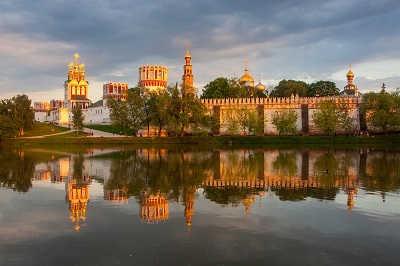
Tour of the Novodevichy Monastery. Founded in 1524 by Grand Prince Vasili Ioanovich, the original convent was enclosed by fortified walls and contained 12 towers. The structure served as a convent for ladies of noble birth and was host to many famous Russian personages throughout its history including Boris Gudonov and Peter the Great’s elder sister Princess Sophia (who was banished there in 1679 by her brother). Places of interest in the convent are Preobrazhenskaya Church (the Church of the Transfiguration), the outstanding Smolensky Sobor (Smolensk Cathedral) and the Novodevichy cemetery in which many notable people are buried including Chekov, Gogol and Stalin’s wife Nadezhda Alliluyeva
Old Arbat
Old Arbat is one of Moscow’s oldest streets. The street has gone from being the headquarters of Ivan the Terrible’s secret police, the Oprichina to the center of aristocratic life in Moscow in the 18th century to finally being the center of the Russian intelligentsia and bohemian life in the capital. The street is now a pedestrian zone home to numerous street performers and artisans who sell souvenirs along the road.
Ostankino
Ostankino park and palace estate, located in the Northern part of Moscow, is a unique example of Russian architecture of the 18th century. Official records of Ostankino date back to the middle of the 16th century. However the estate began to flourish when it became one of the Moscow residences of the Sheremetev family, one of the wealthiest and powerful noble families in Russia during the 18th century. The Sheremetevs owned a quarter of the serfs in the Russian Empire and maintained their fortune by bequeathing the entire estate to the eldest son of each generation, rather than dividing it equally between several heirs. Nikolay Petrovich Sheremetiev is considered to be one of the most educated aristocrats of the 18th century for his great love for art, sciences, literature and especially the theater. That passion drove him to create the magnificent palace in Ostankino. The palace unites under the same roof a library, an art gallery, an armory, scientific rooms and a theater. The theater was opened in 1795 and during a very short time, and thanks to highly professional actors, was on a level equivalent to the Imperial Theater. Praskovia Zhemchugova - the serf star of the theater - later became count Sheremetiev´s wife. In Soviet times, the estate was renovated and opened as a Museum of Serf Art, to commemorate the fact that it was entirely designed and built by serf craftsmen. Nowadays, the theater inside the Ostankino palace is the only Russian and one of the few remaining European theater buildings surviving from the end of the 18th century with its well preserved stage, hall, foyers, make-up rooms and equipment of the upper engine-room.
Pushkin Museum
The Pushkin museum was founded by Professor Tsvetayev of Moscow University as a school for the teaching of art history. It is second only to the Hermitage in Russia, as far as the wealth of its exhibits is concerned - boasting a large selection of world masters among its collection. The picture gallery contains over 2000 canvases, enabling visitors to appreciate the variety of styles over the centuries. The real pride of the museum is its collection of French Impressionists, one of the best in the world. The museum periodically holds visiting exhibitions of art collections from abroad.
Red Square
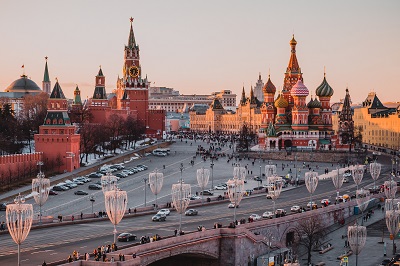
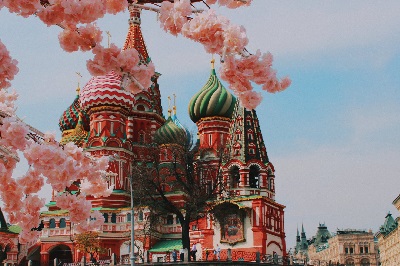
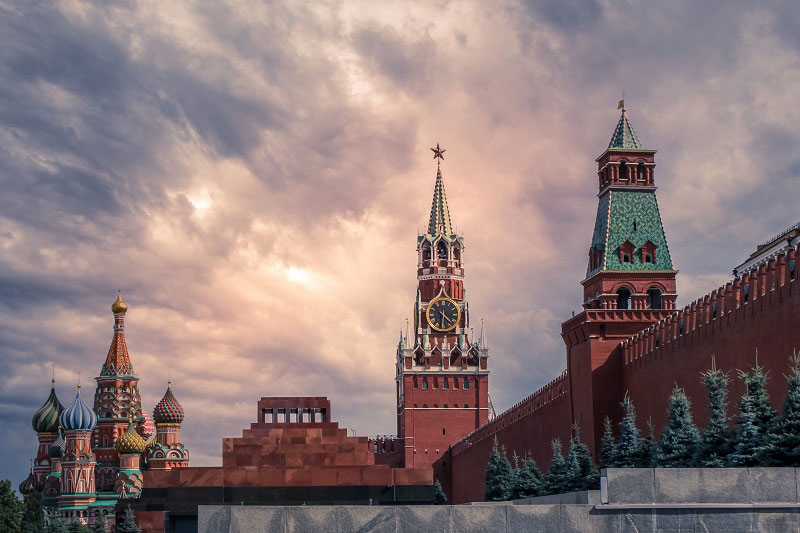
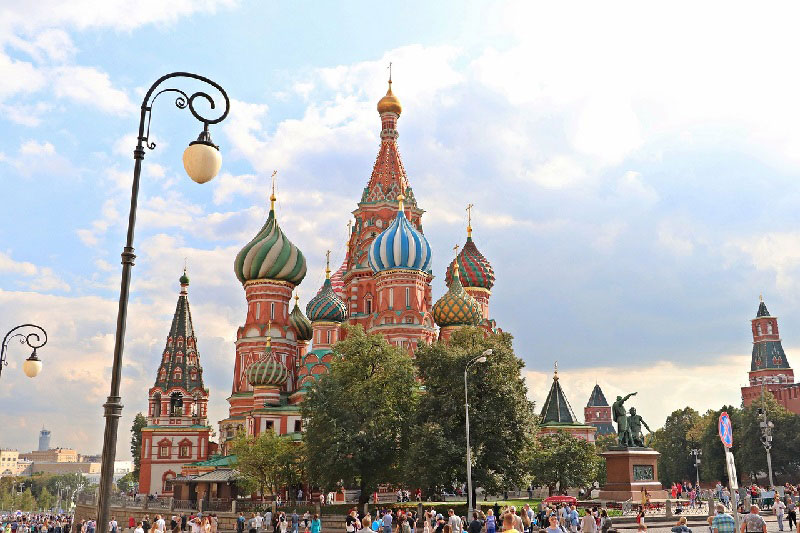
At the very centre of Moscow, beneath the walls of the Kremlin, lies Red Square. Its history dates back to the distant past. Over the centuries, the square has changed its name many times. It was first mentioned in the chronicles of 1434 as the Trade Square, then, after the devastating fire of 1493, it was renamed Fire. In the 16th century they called it Trinity (after the church which formerly stood on the site of St Basil’s Cathedral) and in the 1660s it was given the name “Krasnaya”, which at the time meant “beautiful”, “best” or “main”. Among the sights visitors will see are the statue of Minin and Pozharsky (the leaders of the People’s Volunteer Corps in 1612), the Mausoleum of Lenin, the Upper Trading Rows (including the State Department Store (GUM)), the clock at the Savior (Spasskaya) Tower – showing the most correct Moscow time, the History Museum, the beautiful Cathedral of the Intercession (the Church of St Basil the Blessed), Kazansky Cathedral and many other outstanding pieces of Russian architecture.
The Kremlin
The Kremlin is truly a fascinating structure, at the same time it is an ancient tower, the city’s former military fortification, a palace, an armory, the sovereign treasury and the workplace of the Russian President. The Kremlin is the center of Russia’s political life and State power and has been home to Tsars, General Secretaries of the Soviet Union and Russian Presidents.
Tretyakovsky State Gallery
The world famous gallery contains works of Russian art beginning in the 10th century up until today. You will view exquisite Russian icons and paintings from the 18th and 19th century including works by Rublyov, Karavak, Vishnyakov, Nikitin, Antropov, Levitsky, Kiprensky, Tropinin, Fedotov, Repin and many others.
Tsaritsyno
The Tsaritsyno Estate is located in the southern part of Moscow. The estate was constructed for Catherine the Great by the Russian architects Bazhenov and Kazakov in a romantic gothic style. The complex includes a landscape Park dated from the end of the 18th century, and a unique system of ponds built between the 16th and 17th centuries. The estate is a unique example of an Imperial summer residence that was never completed and never lived in. The collection of the Tsaritsyno museum consists of approximately 30,000 various exhibits. There are masterpieces of Russian and Western European art from the 18th - early 20th century, including an impressive collection of antique tapestries, Russian and Central Asian folk art, contemporary glassware, ceramics, furniture, paintings and a rich archeological collection.
Moscow tourism and St. Petersburg tourism are our specialties